Domaine des Marronniers--Chablis
Bernard Legland owns fifteen hectare of vines. The plots are
located in Courgis, Prehy and Chablis proper. The domaine produces
wines from four AOCs: Bourgogne, Petite Chablis, Chablis,
and Chablis 1er Cru.
Bernard's Petite Chablis comes from just 4 hectares around
the 1er Cru Montmains. He has learned to make the most out of
very little and the Petit Chablis is now over acheiving. The Chablis
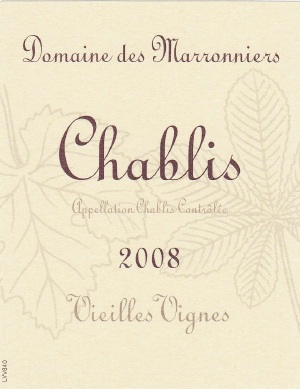
V.V. is sourced from a small portion of his 11 hectares of Chablis
AOC. The aesthetic is conservative. The wines are tight and austere.
The shimmering acidity and dense minerality make the Chardonnay's
fruit walk upright and stand erect.
The top soil is calcareous marl and clay. There is a significant admixture
of pebbles from the kimmeridgian sub soil. |  |
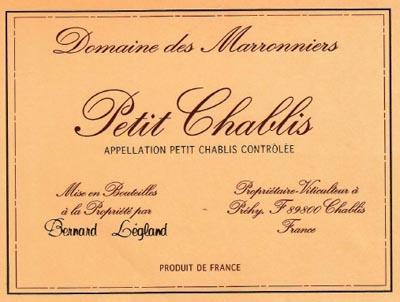
Petit Chablis
Size of plot: 4 ha 40
How long is the plot owned by the producer: 30 years
Bottles produced: 15 000 bottles
100 % Chardonnay
Age of vines: 15 year
Slope, exposure and altitude of plot: 300 m alt., west exposure,
5% slope
Name of other producers surrounding the parcel: Domaine
J-M Brocard, Domaine Bardet & Fils
Soil types: Chalky-calcareous
Number of vines per hectare: 5500 vines per hectare
Vine training system: Low vineyard training on wires (trellising
structure) Guyot double (1 spur and 2 canes) , pruning
begins in December and finish in March.
Average number of bunches per vine: 16 bunches.
Do you plough? How often? Yes. 2 to 3 times
Maintenance of vineyard soil by ploughing and scraping.
Copper, sulfur or any other type of treatment: Copper 1
time, sulfur 3 times.
Destemmed
Direct pressing in pneumatic press.
Fermentation how long: 8 days
Yeast type, indigenous or selected: Selected yeast
If selected yeast what kind and how much: Saccharomyces
cerevisiae
| |
Temperature controlled fermentation: 20 °C
Size of barrel for fermentation, wood or steel: Stainless
steel tank
Malolactic fermentation total/partial, how long:
Total malolactic fermentation, one month.
Batonnage: Resuspension of lees at racking (once malolactic
fermentation is completed) and one or two times
during maturing of wines (depending). Every vintage is
different.
|
